Framing the Problem
The initial problem statement for the product I was working on was to provide the users with tools in a business critical step that was a part of the overall process we are providing solutions to. The project had some prior UX work put into it and the outcome, at the time, was a Kanban-like board that was meant to provide an overview of the different projects and the current stages each project was in. Specifically the issue I was asked to find a good solution for was the step of evaluating public procurements as business opportunities. The work that we previously had was research in to the activities companies were doing when evaluating these business opportunities. To accompany this research we also had some prototypes that would solve some of the main problems that the users had voiced in the research. Mainly the issue was lack of an overview of the different public procurements that the users/companies were looking at or working with.
After getting an introduction to the sketches and the key findings, together with going through the research documentation myself. I found that we were lacking a more detailed insight into the process of evaluating these business opportunities. And that there was a significant amount of collaboration going on but we needed more knowledge about what type of collaboration this was.
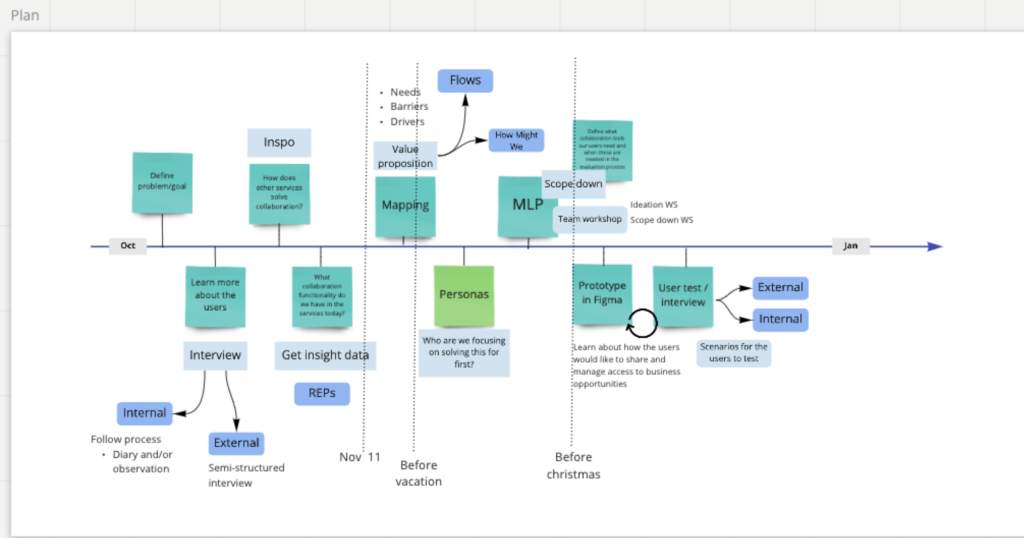
I then created the project together with my supervisor/mentor both to agree on the direction but also to set a goal for where we would like to be with the service by the end of the year. Part of this project plan is shown as the timeline underneath.
Research
The natural next step was to talk to gather insights from users, which I did via online interviews. I chose this data gathering method due to the practicality and the fact that the corona pandemic was still lingering thus meeting in a physical setting was not something I would try force my interviewees to do.
Furthermore actually setting up the interviews was something of a task, which was unexpected to me. There were several factors but the most significant ones was that our target group (medium sized companies) weren’t as visible in our systems versus the large companies, much of the contact information we had was for managers of the users of our service and not the actual user, and we had no explicit consent from the users regarding us contacting them about testing thus the response rate for the emails I sent were quite low initially.
After having set up and conducted most of the, eventual, 6 interviews I began looking at the findings. In spite of my best efforts to get to talk to users from medium sized companies I still ended up with 3-4 interviewees from large companies, which I suspected to be reflected in the user insights. One trend I suspected was confirmed after the 3rd interview, which showed that large companies has a fairly set process for this type of business opportunity evaluation.
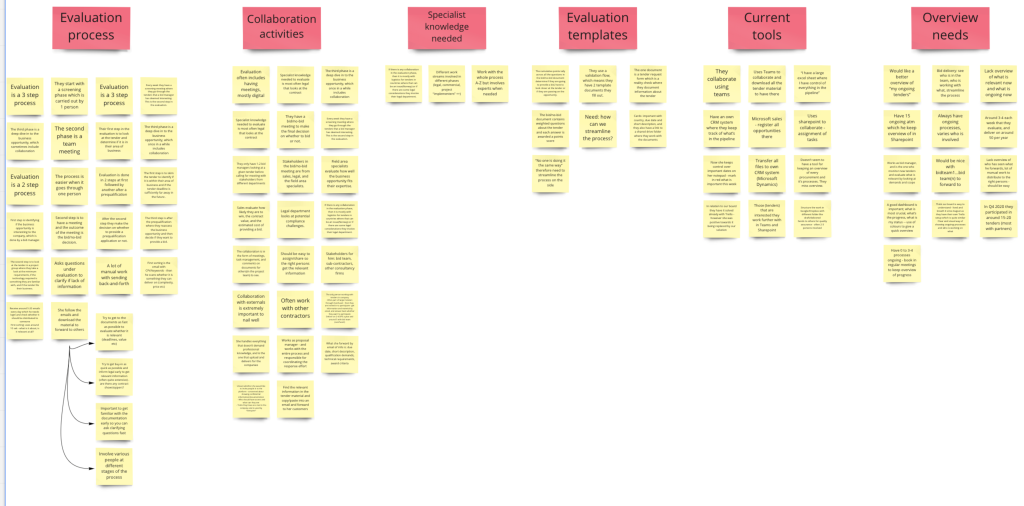
To analyze the user insights I elected to make an affinity diagram based in my prior experience and on the advice I got from my supervisor. I had been 3-4 years out of doing traditional UX design and employing the established methods, which naturally induced a fair bit of rust to my application of these methods. The result of this was that I had to make 2 versions of the analysis as the first one didn’t enable my to make any hypothesis that would be easy to test. The outcome of the first diagram is what you see above this paragraph.
The main issue with this affinity diagram is that I created groups of insights that were to vague. Thus it was creating an overview of some themes in the research but the overview didn’t help us in the direction of solving the users’ problems.
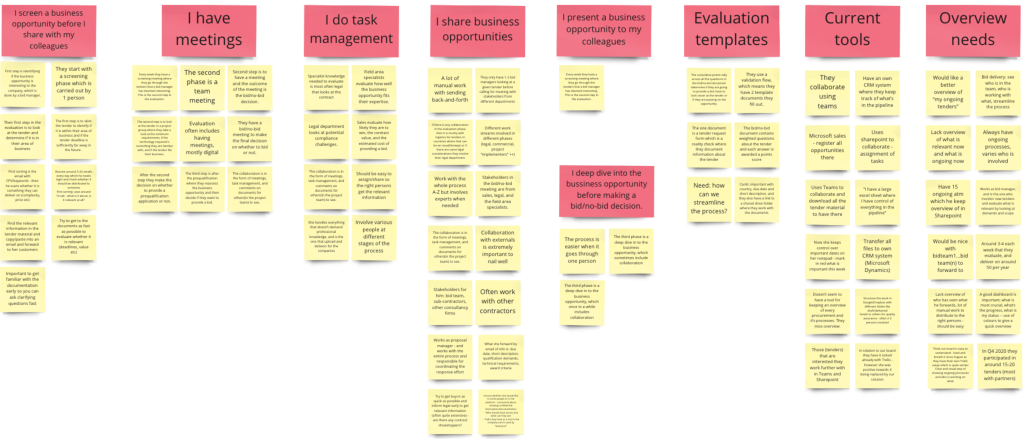
The second version of the affinity diagram was more focused on the concrete activities and tasks the users were doing when evaluating the business opportunities. The framing of the interview was also how the users collaborated, which is what I focused on in the beginning of the analysis. A reflection about the application of affinity diagrams I have, is that the grouping of insights might yield a more meaningful outcome if the designer focus these groups around common problems or common user actions.
What is apparent from the second affinity diagram is that we have users that share business opportunities with others, users that have meetings with a group of stakeholders about these business opportunities, and that there is a degree of task management involved when evaluating these business opportunities. These 3 findings were from my point of view the primary user activities we should focus on to solve the issues associated with collaboration in the evaluation step.
I wrote 3 hypothesis based on these findings and prioritized them according to confidence in the hypothesis being correct across the majority of our customer base. The main hypothesis was concerned with providing the most important insight in to the business opportunity for the company in order to efficiently discuss these business opportunities in meetings and settle on a path forward. The other hypotheses were concerned with task management and sharing business opportunities respectively.
Design Proposition
My proposed solution to the main hypothesis is a notes taking feature that would enable a user to take notes about the important factors of a given business opportunity and store them on a seperate page in the business opportunity project. This proposition doesn’t necessarily provide a significant amount of value to the user on it’s own. But when the ability to take notes is coupled with the ability to share business opportunities we get to actually collaborate on evaluating bussines opportunities from different computers and the users might be able to help eachother qualify the notes better to a degree where a meeting might not be necessary. Additionally the notes taking feature itself could have great synergy with a task management feature which I would have proposed sometime in the future.
Some other reflections regarding my proposition was that notes taking is quite flexible and can yield value for users in big companies where having meetings and presenting business opportunities is common. But also for small companies where the user might not collaborate yet this user still needs to keep track of all the aspects in the given business opportunity, which in public procurement is often really complicated.